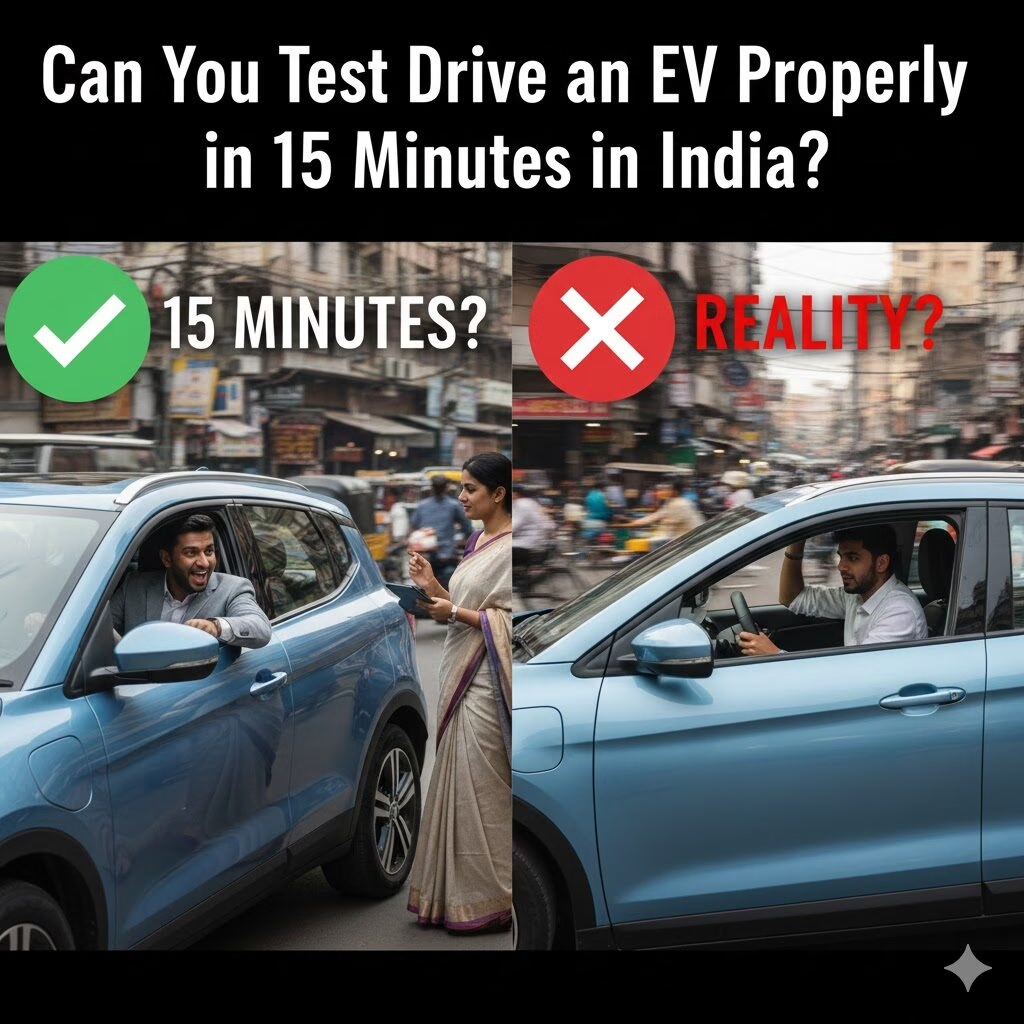
You’re at the dealership, excited but pressed for time. The salesperson says, “We have a 15-minute test drive slot.” Your heart sinks. Can you test drive an EV properly in 15 minutes in India? The short answer is yes, if you’re strategic. Unlike a petrol car where you check engine refinement, an EV test drive is about feeling a different kind of performance. You need to focus on the right elements.
This guide gives you a precise, minute-by-minute plan to evaluate the most important aspects of an electric vehicle in a short burst, ensuring you don’t miss what truly matters.
The 5-Minute Pre-Drive Checklist: Don’t Even Start the Car Yet!
Before you turn the key (or press the start button), use your first five minutes wisely. This is where you assess daily usability.
Minute 1-2: The “Socket for EV Charging” & Cable Check
- Action: Pop open the charging port. Don’t just look—ask.
- What to Ask: “What type of EV charging connector types in India does this support? Is it just the standard Type 2/AC001, or does it have CCS2 for DC fast charging?” Know what you’re buying. A car with only a slow AC charger might not suit impromptu road trips.
- LSI Check: Look for the charging cable stored in the boot. Is it a Type C EV charger (commonly called Type 2 in India)? Is it cumbersome? This is your daily reality.
Minute 3-4: Cockpit Familiarity & Tech
- Action: Sit in the driver’s seat. Adjust it. Don’t start the car.
- What to Check: Find the regenerative braking adjustment (often paddles or menu). Locate the drive modes (Eco, Normal, Sport). Can you reach the touchscreen easily? Is the digital cluster clear? This simulates your daily interaction before you even move.
Minute 5: Space & Practicality
- Action: Check the rear seat legroom and the boot. Can it fit your child’s scooter or weekend luggage? An EV’s battery pack can sometimes eat into cabin or boot space.
The 8-Minute On-Road Sprint: Testing How an Electric Vehicle Works in Real Traffic
Now, you drive. Your goal is to experience the EV’s unique character.
Minute 1-3: The Silent Launch & City Crawl
- Action: Drive out of the dealership onto a mixed road.
- Feel the Torque: EVs deliver power instantly. From a standstill, gently press the accelerator. Does it surge smoothly or jerkily? This is crucial for bumper-to-bumper traffic in Delhi or Bangalore.
- Test Regeneration: Use the regen paddle or switch to a high-regen mode. Feel how quickly the car slows when you lift off the accelerator. Strong regen can enable one-pedal driving, a huge perk in city commutes.
Minute 4-6: Ride & Refinement
- Action: Find a rough patch or a speed bump.
- What to Check: Does the suspension thud or absorb calmly? EVs are heavy due to the battery, so suspension tuning is key. Listen for cabin noise. The lack of engine sound makes tyre and wind noise more apparent.
Minute 7-8: A Glimpse of Performance
- Action: If safe, find a short open stretch.
- Test Overtaking: In Sport mode, do a quick 40-80 km/h overtaking maneuver. The seamless, silent rush of power is an EV’s party trick. Does it feel confident?
The 2-Minute Post-Drive Debrief: Asking the Right Questions
You’re back. Don’t just hand over the keys. Use these final minutes to get critical data.
Ask These Specific Questions:
- “What is the real-world range, not the ARAI figure, in city traffic with AC on?” (Stats: Most EVs deliver 15-25% less than the certified range in real-world Indian conditions).
- “If I only have a standard 3-pin socket for EV charging at home, how long to charge EV on 120v (a 15A socket)?” (Real Example: A Tata Nexon EV with a 30kWh usable battery can take ~18 hours for 10-100% on a 15A socket. This is a dealbreaker for many).
- “What is the fast electric car chargers near me situation? Can you show me the map of compatible DC fast chargers for this model on my route?” (Case Study: A Hyundai Kona owner from Pune noted that planning via the “Zeon Charging” app was essential for his Mumbai trips, highlighting the need for infrastructure checks).
Key Takeaways & Your 15-Minute Test Drive Plan
| Minute | Focus Area | Key Question to Answer |
| 1-5 | Static Inspection | Do the charging options and cabin space fit my life? |
| 6-13 | Dynamic Drive | Does the acceleration, ride quality, and regen feel good in my driving environment? |
| 14-15 | Fact-Finding | What are the real-world range and charging times for my living situation? |
The Verdict: Yes, a focused 15-minute test drive can tell you 80% of what you need to know—if you shift your focus from engine sound to instant torque, from fuel gauge anxiety to range display clarity, and from petrol pump proximity to charging socket compatibility.
Conclusion: It’s About Quality, Not Just Quantity
You can absolutely conduct an effective EV test drive in 15 minutes in India. The secret is to stop thinking like a petrol car buyer. Prioritize the EV-specific experience: the silent punch, the one-pedal driving feel, the charging logistics, and the tech interface.
Walk into the dealership with this checklist. It transforms a rushed spin into a structured evaluation, ensuring you invest in a car that suits not just your budget, but your daily reality in India’s unique driving landscape.
Frequently Asked Questions (FAQs)
Q1: What is the most important thing to test in a short EV test drive?
The most critical thing is regenerative braking and low-speed acceleration. This defines your daily city driving experience. Ensure the car’s deceleration and pickup feel comfortable and intuitive to you in traffic.
Q2: I live in an apartment. What charging question is a must-ask?
Absolutely ask: “If I can only use a regular 15A home socket for EV charging, what is the full charging time?” This will immediately tell you if the car is practical for you or if you need to invest in a faster home charger.
Q3: How can I check the EV charging connector types in India for the car?
Simply ask the sales executive to show you the charging port. Look for two sockets: a larger one for AC charging (Type 2) and possibly a smaller, two-pinned bottom section for DC fast charging (CCS2). If it only has one, it likely lacks fast-charging capability.
Q4: Is there a quick way to find fast electric car chargers near me for the model I’m testing?
Yes. Ask the salesperson to open the car’s built-in navigation app or the manufacturer’s companion app (like Tata’s ZConnect or MG’s i-SMART) and show you the live map of compatible charging stations along your regular routes.
Q5: Why is test-driving an EV different from a petrol car?
The difference is in the priorities. In a petrol car, you listen to the engine and feel gear shifts. In an EV, you evaluate how electric vehicle works through instant torque, silent operation, brake regen strength, and the tech that manages range and charging. The driving fundamentals are the same, but the experience is fundamentally different.