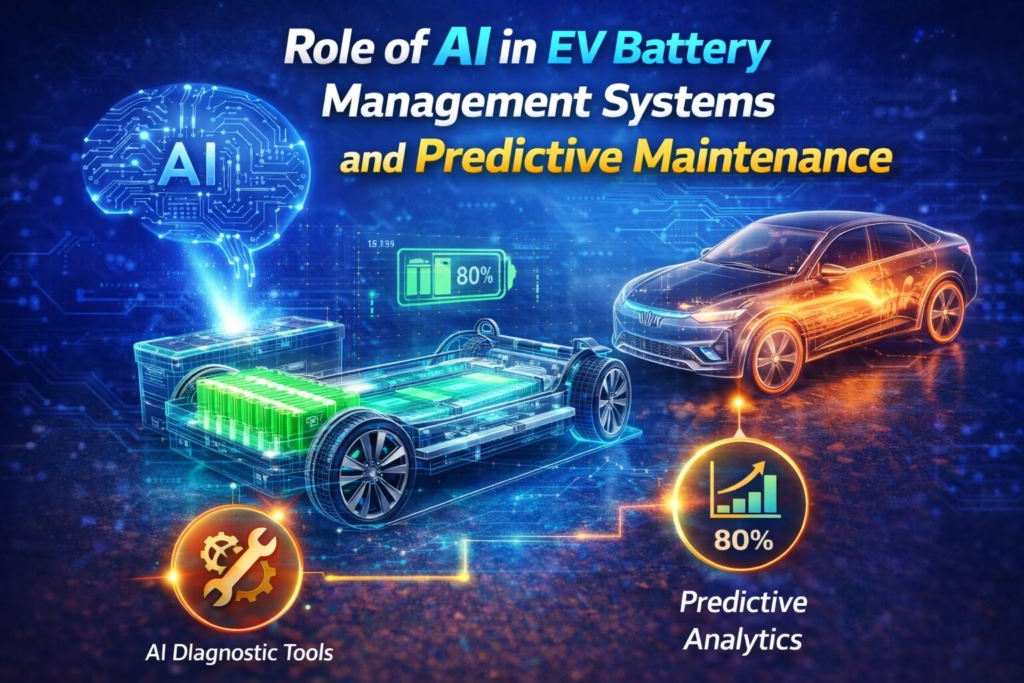
Electric vehicles (EVs) depend on complex battery systems that must perform safely, reliably, and efficiently under many real-world conditions. At the heart of this performance lies the Battery Management System (BMS)—the electronic brain that monitors, protects, and manages battery operation. With advances in artificial intelligence (AI), modern BMS technologies are becoming smarter, predictive, and adaptive, transforming how EV batteries are monitored, maintained, and optimized across their lifecycle. This blog explains how AI enhances EV battery management, supports predictive maintenance, and helps simulate a BMS in a renewable energy storage system, while also considering real-world risks from typical BMS failure modes.
What Is a Battery Management System (BMS)?
A Battery Management Systems is an electronic and software system that monitors and manages rechargeable batteries—whether in EVs, renewable energy storage, laptops, or other applications. In EVs, a BMS:
- Monitors cell voltage, current, and temperature
- Estimates key metrics like state of charge (SOC) and state of health (SOH)
- Controls charging and discharging to protect cells
- Balances cells to maximize usable capacity
- Interfaces with vehicle systems for safety and performance data
Without a reliable BMS, battery packs can degrade faster, underperform, or even face safety issues like thermal runaway.
Why AI Matters in EV BMS Technology
Traditional BMS approaches use predefined mathematical models and filters that have limitations in capturing complex battery behavior—especially as batteries age, temperature varies, and usage patterns change. AI changes this by learning from data and predicting future behavior, not just reacting to current conditions. AI’s role in EV battery management systems includes:
1. Precise State Estimation
AI algorithms can provide highly accurate estimates of a battery’s SOC and SOH, which describe how much charge remains and the battery’s overall health, respectively. AI models learn from voltage, current, and temperature data, allowing them to model complex relationships that traditional methods struggle with.
Accurate SOC and SOH predictions help EVs manage energy use more efficiently, extend battery life, and give drivers reliable range estimates.
2. Predictive Maintenance
Predictive maintenance shifts EV battery care from routine replacements to need-based servicing by identifying early signs of degradation or faults. AI achieves this by:
- Continuously analyzing sensor data
- Detecting subtle patterns that precede problems
- Estimating remaining useful life and fault likelihood
This approach prevents failures before they happen, cutting downtime and costly emergency repairs. Predictive maintenance is fundamentally about forecasting when components will need attention rather than waiting for a failure or checking at arbitrary intervals.
3. Adaptive and Self-Learning BMS
Modern AI-driven BMSs can adjust their behavior over time, learning from new data. For example:
- Adjust charging or thermal management strategies based on usage patterns
- Fine-tune predictions of SOH as conditions change
- Recognize patterns like frequent deep discharges or extreme temperature exposure, and adapt the battery management strategy accordingly
This adaptability enhances performance and ensures the battery is managed with evolving conditions in mind.
Predictive Analytics: What It Means for Maintenance
Predictive maintenance hinges on the ability to forecast when and how a battery might fail. AI models use historical and real-time data to estimate future states, helping engineers and fleet managers:
- Schedule service tasks only when necessary
- Avoid costly unscheduled downtime
- Extend battery service life and lower total cost of ownership
This is much more efficient than traditional routine checkups, which can either miss early issues or waste effort when no problem exists.
AI in Renewable Energy Storage and BMS Simulation
AI’s impact extends beyond EVs. In large renewable energy storage systems (such as solar farms coupled with battery banks), AI-enabled BMSs are being used to:
- Simulate battery behavior under different charge/discharge scenarios
- Model how batteries will perform over years of cycling and variable loads
- Predict degradation and adapt control logic for safety and longevity
Simulation models can replicate battery dynamics to support design decisions, optimize operations, and assess long-term efficiency. These simulations help engineers design and validate BMS strategies before hardware deployment, which is crucial for large grid storage applications.
Common BMS Failure Modes and How AI Helps
Even sophisticated BMS hardware can experience issues. Some recurring failure modes include:
- Thermal runaway or overheating due to poor temperature control
- Cell imbalance where cells diverge in voltage or charge level
- Overcharging or over-discharging because of faulty detection
- Communication breakdowns between BMS and vehicle control units
- Sensor errors or calibration issues that lead to incorrect readings
AI enhances early detection of these conditions by analyzing trends in sensor data more effectively than simple threshold checks. For example, an AI model might detect subtle increases in internal resistance that suggest future degradation, triggering a maintenance alert before performance drops. This predictive capability turns BMS systems from reactive safety monitors into proactive protectors.
Benefits of AI-Enhanced BMS Technology
AI integration yields quantifiable benefits:
- Improved accuracy in SOC and SOH estimates, enabling better energy management
- Reduced unplanned failures, thanks to early anomaly detection
- Longer battery life, through optimized charge and thermal strategies
- Lower maintenance costs, because interventions happen only when needed
- Better safety outcomes, by predicting conditions that lead to failures
FAQs
What does “simulate a BMS in a renewable energy storage system” mean?
It refers to creating a computer model of how a battery management system will behave in a real-world renewable energy application. This simulation helps engineers test charging strategies, thermal control, and predictive maintenance logic before deployment. Simulation supports safer, more efficient system design.
What are typical BMS failure modes?
Common failure modes include thermal runaway, cell imbalance, over-charge/over-discharge, communication errors, and sensor inaccuracies. These can compromise performance and safety if not predicted or managed.
Summary
Artificial intelligence is transforming EV battery management systems from simple monitoring units into intelligent, adaptive, and predictive platforms. AI enhances the accuracy of state estimation, enables predictive maintenance, and supports advanced simulation of battery behavior—whether in electric vehicles or renewable energy storage systems. By detecting early signs of problems and adapting to real-time conditions, AI-enabled BMSs ensure safer, efficient, and longer-lasting battery operation, redefining how future EVs and energy storage systems are designed and maintained.