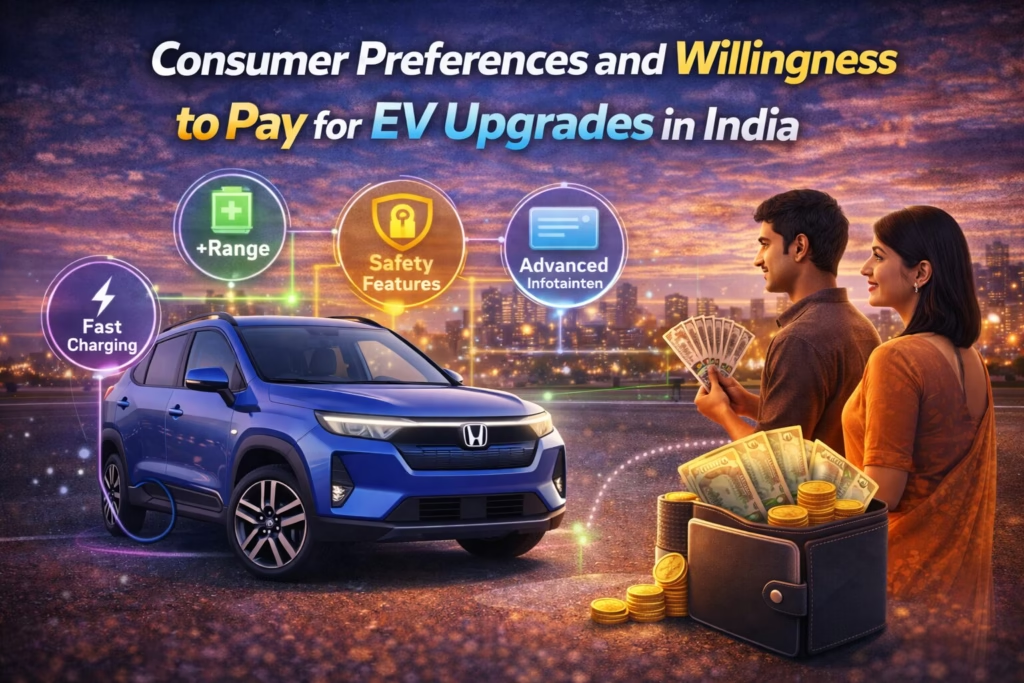
Electric vehicles (EVs) are no longer a niche trend in India. As environmental awareness grows, policy support strengthens, and prices become more competitive, Indian consumers are increasingly evaluating EVs not just as transport options but as lifestyle choices. However, the decision to buy or upgrade an EV is shaped by preferences, perceptions, and willingness to pay (WTP) — a concept at the heart of behavioral economics.
This blog explores how Indian consumers think about EV purchases, what features they value most, and how much extra they are willing to pay for key EV upgrades. Understanding these motivational factors helps automakers, policymakers, and marketers tailor strategies that boost EV adoption in India’s evolving electric vehicle landscape.
What Are Indian Consumers Willing to Pay for EV Upgrades?
Research on willingness to pay and attitudinal preferences of Indian consumers for electric vehicles shows that consumers are ready to pay a premium for improved EV features — but the premium varies depending on the attribute.
According to this study of consumer preferences:
- Indian consumers will pay US$10–34 extra in purchase price to reduce fast charging time by 1 minute.
- They are willing to pay about US$7–40 per extra kilometer of driving range at 200 kilometers.
- For each US$1 reduction in operating cost per 100 kilometers, consumers would pay US$104–692 additional purchase price.
These figures clearly indicate that range, charging speed, and operating costs are among the strongest drivers of consumer preference and WTP in the Indian EV market.
Why Do EV Features Influence Willingness to Pay?
When deciding on upgrades, consumers focus on practical attributes rather than purely aesthetic ones. The top priority areas include:
- Range Anxiety and Driving Range
Many Indian buyers hesitate due to concerns about limited range and charging infrastructure. Cars with longer range provide peace of mind, especially when planning inter-city travel. Increasing the range therefore directly increases perceived value. - Charging Time and Convenience
Charging infrastructure is improving but still uneven. Faster charging reduces wait time and increases usability, which many consumers are willing to pay more for. - Running Cost Savings
EVs promise lower total cost of ownership (TCO) compared to internal combustion vehicles. Buyers value long-term energy and maintenance savings and are willing to pay upfront for features that improve these economics.
These preferences reflect a blend of economic rationality (lower running costs) and practical user experience (range and charging convenience).
What Factors Shape Consumer EV Preferences in India?
Consumer behavior research shows that preferences are influenced by factors beyond pure economics. Psychological and social factors also play a role, although these are less well quantified in Indian literature than in global EV studies. Studies show that:
- Information about EV benefits affects purchase intentions — the more informed consumers are about savings and sustainability, the more positive their attitudes.
- Environmental concerns and interest in green technologies can boost willingness to adopt EVs.
- Perceived risks such as fear of limited charging infrastructure or higher upfront costs can dampen enthusiasm, especially among middle-income groups.
While the Indian context has unique features (like strong two-wheeler dominance and cost sensitivity), these attitudinal elements are consistent with global EV adoption research.
What Does Electric Vehicle Data Show in India?
India’s EV landscape has grown significantly in recent years:
- EV sales in India increased from 50,000 in 2016 to over 2 million in 2024, and total stock reached about 5.45 million vehicles — though this represents only a small fraction of the global total.
- Growth trends show that EV adoption is strongest where charging infrastructure and government incentives are well established.
Recent registrations also reflect shifting consumer interest: urban areas like Bhubaneswar have seen over 50% annual growth in EV sales for both cars and scooters, driven partly by cost savings and model variety.
This electric vehicle data in India highlights that while volume is rising, consumer demand remains sensitive to price, range, and usage convenience — exactly the factors that drive willingness to pay for upgrades.
How Does the EV Scenario in India Affect WTP?
The EV scenario in India is shaped by a combination of policy, infrastructure, and consumer perception:
- Government incentives like the FAME program and future schemes aim to reduce upfront cost barriers and stimulate adoption.
- Charging infrastructure expansion is ongoing but uneven, reinforcing preferences for vehicles with better range or fast charging compatibility.
- Manufacturers like Tata Motors and Mahindra are launching new EV models that target specific segments — from affordable city cars to premium SUVs — influencing consumer choices.
These trends influence how much consumers are willing to pay for upgrades: if infrastructure improves, the perceived value of features like charging efficiency and range also changes.
What Is the Role of the EV Leasing Market in India?
An emerging trend is the EV leasing market in India, which allows consumers to access EVs without large upfront costs. This model can shift willingness to pay — rather than paying extra for upgrades upfront, users may opt for leasing packages that bundle advanced features. Leasing also reduces risk for price-sensitive buyers by offering flexible terms.
Leasing platforms are particularly attractive to urban professionals, commercial fleets, and users who prioritize flexibility over ownership — and these users may value operational benefits like low running cost over premium features.
How Do Consumer Preferences Differ Across Segments?
Consumer segments in India show varied patterns:
- First-time EV buyers often seek affordability and basic functionality.
- Tech-savvy buyers prioritize fast charging, connectivity, and range.
- Fleet buyers and gig drivers emphasize reliability, TCO, and operating cost savings.
Studies suggest that reference dependence — comparing EV attributes directly to traditional vehicles — plays a critical role in calibrating WTP estimates. Consumers don’t evaluate EVs in isolation; they benchmark them against what they already know (petrol/diesel cars), which affects how much premium they are willing to pay for improvements.
FAQs
What does “willingness to pay and attitudinal preferences of Indian consumers for electric vehicles” mean?
It refers to how much extra Indian buyers are willing to spend on specific EV enhancements (like faster charging or longer range) and how their attitudes toward EV features shape those decisions.
How does the EV scenario in India affect consumer willingness to pay?
The current market’s growth, charging infrastructure expansion, and government policies influence consumer preferences and how much value buyers assign to certain EV features.
What role does the EV leasing market in India play in consumer EV preferences?
Leasing offers a way for consumers to access EVs without high upfront costs, making advanced features more accessible and potentially increasing demand for premium attributes through subscription models.
Conclusion
Indian consumers are showing increasing willingness to adopt electric vehicles and pay premiums for features that address their core concerns — especially charging speed, driving range, and cost savings. Behavioral economics research shows that preferences are shaped by both practical and psychological factors. By understanding these drivers and tailoring EV offerings — including pricing, leasing options, and upgrade packages — automakers and policymakers can accelerate EV adoption across Indian market segments.