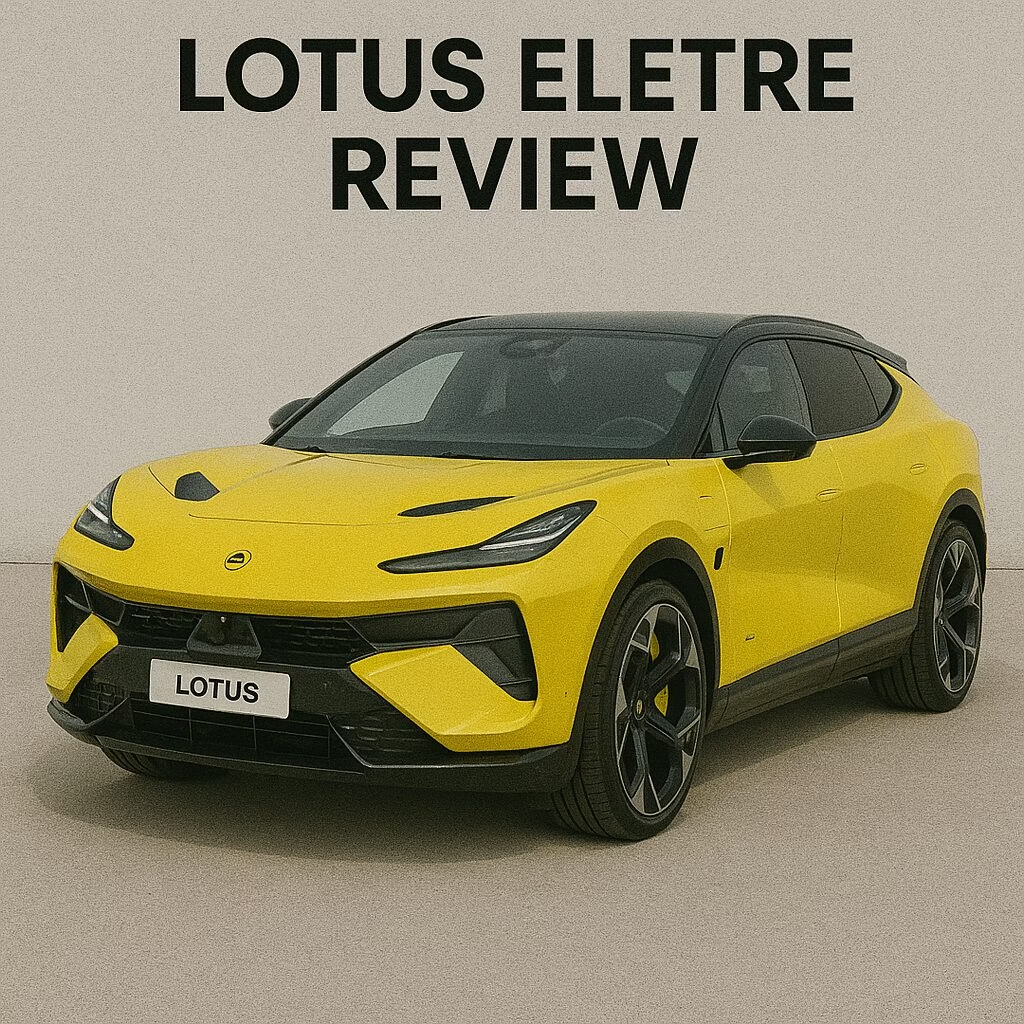
For over 70 years, Lotus built its legend on lightweight sports cars with names like Elise and Exige. Today, it’s building an all-electric, high-riding, four-door colossus called the Lotus Eletre. This isn’t just Lotus’s first SUV; it’s being hailed as the world’s first “Hyper-SUV.” It represents the most radical transformation in the brand’s history, landing in India to challenge everything from the Lamborghini Urus to the Audi RS e-tron GT. With a Lotus Eletre price in India that competes with supercars, the question is: Has Lotus sold its soul, or has it ingeniously evolved it for a new era?
This review dissects whether the Eletre retains the “Lotus feeling” while offering a level of practicality and tech the brand has never before attempted.
First Impressions: A Spaceship That Learned to Off-Road
The Lotus Eletre looks like nothing else on the road. It’s a dramatic, cab-forward, aerodynamic sculpture that manages to look both planted and futuristic. Sharp lines, active aerodynamic elements (including a deployable rear spoiler), and piercing LED light signatures give it an unmistakable presence. It’s lower and sleeker than a traditional SUV, sitting closer to a high-riding liftback.
On Indian roads, the Eletre will look like it’s arrived from 2030. It’s a bold, confident design that makes a statement of intent: performance and technology above all else.
Hyper-SUV Performance: The Numbers Are Mind-Bending
The “Hyper” in Hyper-SUV is not marketing fluff. The Eletre’s performance specs are firmly in the realm of supercars.
Core Performance Specs:
- Powertrain: Dual or Triple Electric Motor setups (for the top R variant), All-Wheel Drive.
- Lotus Eletre HP: Ranges from 603 hp in the base model to a staggering 905 hp in the range-topping Eletre R.
- Torque: From 710 Nm to over 985 Nm.
- 0-100 km/h: As quick as 2.95 seconds for the R variant.
- Lotus Eletre R Top Speed: An electronically governed 265 km/h (165 mph).
But this is a 2.5-tonne SUV. The magic lies in its chassis tech: active air suspension, rear-wheel steering (up to 3.5 degrees), and an active anti-roll system. It promises to shrink around you, feeling agile and responsive in a way that defies its size and weight.
The Digital Sanctuary: Lotus Eletre Interior
Step inside the Lotus Eletre interior, and you leave the analog Lotus world completely behind. This is a minimalist, digital cocoon focused on sustainable luxury and immersive tech.
Interior Highlights:
- Sustainable Innovation: Extensive use of recycled materials—carbon fiber, polyester, and even wool blend fabrics. It’s luxury with a conscience.
- The Tech Orchestra: A slim, ribbon-like instrument cluster flows into a massive 15.1-inch OLED central touchscreen that can slide down to reveal storage. A secondary screen for the passenger is optional.
- KEF Audio with Dolby Atmos: An optional 23-speaker, 2,160-watt 3D surround sound system by British audio legends KEF.
- Ergonomics & Space: Despite the sloping roofline, there is generous space for four adults, with a truly massive panoramic glass roof. The boot is a practical 688 liters.
It’s a serene, futuristic environment that prioritizes the digital experience and passenger comfort, a world away from the Spartan cabins of Lotus’s past.
The Cost of the Hyper-SUV Revolution: Lotus Eletre Price in India
Revolution doesn’t come cheap. As a low-volume, fully imported CBU with cutting-edge tech, the Eletre commands a premium that places it among exotics.
- Global Starting Price: Begins at approx. $130,000 (₹1.08 Crore) internationally.
- Lotus Eletre Price in India (Estimated): Factoring in CBU duties (over 100%), the base Eletre is expected to start from ₹2.3 – ₹2.7 Crore (ex-showroom).
- Lotus Eletre on Road Price in India: In a metro like Delhi or Mumbai, with registration and taxes, the on-road price will comfortably cross ₹3 Crore for a base model.
- Lotus Eletre R Price: The 905 hp flagship R variant could command a ₹1 Crore+ premium, pushing its on-road price perilously close to ₹4 Crore.
This makes it more expensive than a Lamborghini Urus, positioning it as one of the most exclusive and expensive vehicles in the country.
Who is Behind It? Understanding the Lotus Eletre Company
The Lotus Eletre company is no longer the small, independent British sports car maker. It is now Lotus Technology, a global electric performance arm under the massive Chinese automotive conglomerate, Geely (which also owns Volvo and Polestar). This partnership provides the immense R&D budget and technical resources needed to develop a car as complex as the Eletre. While purists may balk, this is the financial reality that has allowed Lotus to not just survive but boldly leap into the future.
Driving the Unthinkable: Can an SUV Handle Like a Lotus?
Early international drives reveal a shocking truth: it can. Journalists report that the Eletre, especially with rear-wheel steering, feels incredibly nimble and responsive for its size. The steering is precise and full of feedback. In its most aggressive drive mode, it’s devastatingly fast and capable. However, the sheer physics of its weight are felt under extreme braking and direction changes—it’s a miracle of engineering, but not a miracle worker. It redefines what’s possible for an SUV, but doesn’t erase the segment’s inherent compromises.
Pros & Cons: The Ultimate Luxury Performance Statement?
Pros:
- Unprecedented Performance: Supercar acceleration and top speed in a practical SUV body.
- Bold, Futuristic Design: A head-turning statement of avant-garde style.
- Tech-Laden, Sustainable Interior: A beautiful, minimalist cabin packed with innovation.
- Surprising Agility: Chassis technology that makes it feel much smaller than it is.
Cons:
- Astronomical Price: Makes it a possession for the 0.001%.
- Weight & Physics: Despite the tech, it cannot mimic the agility of a lightweight Lotus sports car.
- Untested Brand in Luxury SUV Segment: A huge gamble for buyers used to Porsche, Bentley, or Lamborghini.
- Service & Reliability Unknowns: A complex, new-tech car with a nascent service network in India poses risks.
Verdict: A Daring, Flawed Masterpiece for a New World
The Lotus Eletre is a breathtaking achievement. It proves that the soul of Lotus—clever engineering, driver engagement, striking design—can be scaled and electrified into a vehicle type the brand’s founders could never have imagined.
It is not, and cannot be, an Elise. It is something entirely new: a hyper-performance, tech-centric luxury SUV that carries the Lotus badge into uncharted territory. For the Indian billionaire who already owns a fleet of supercars and luxury SUVs, the Eletre offers a unique proposition: staggering performance, jaw-dropping design, and the exclusivity of being first.
Is it a “real” Lotus? That debate will rage among purists. But as a standalone product, the Lotus Eletre India launch marks the arrival of a fearless, flawed, and fascinating hyper-SUV that has successfully rewritten its own rulebook.
Frequently Asked Questions (FAQs)
Q1: What is the real-world range of the Lotus Eletre in India?
Lotus claims a WLTP range of up to 600 km. In realistic Indian conditions (mixed driving, AC on), expect a practical range of 400-480 km for the base models and slightly less for the high-performance R variant.
Q2: How does it compare to the Lamborghini Urus?
The Lamborghini Urus is a loud, dramatic, combustion-engined statement of excess. The Lotus Eletre is its silent, electric, tech-focused counterpart. The Eletre will likely match or beat the Urus in a straight line (0-100 km/h) and offers a more futuristic interior. The Urus has the benefit of an established brand aura and a roaring V8 soundtrack. The choice is between traditional super-SUV drama and silent electric hyper-tech.
Q3: Can the Eletre handle rough Indian roads?
With its standard air suspension (which can raise the ride height) and considerable ground clearance, it should handle broken roads and speed bumps better than a low-sportscar. However, its massive, low-profile performance tyres and expensive carbon fiber elements make it unsuitable for genuine off-roading or extremely poor roads.
Q4: Where will Lotus Eletre be sold and serviced in India?
Lotus is establishing exclusive retail “experience centers” in major metros like Delhi NCR and Mumbai, likely through a partnership with a premium automotive retail group. Service will be highly specialized, low-volume, and concierge-based. Confirming the location and capability of your nearest center is step one before considering a purchase.
Q5: Is there a more affordable Eletre variant coming?
Currently, only high-performance variants have been announced. A lower-powered, potentially more affordable single-motor variant could be introduced later to broaden the market, similar to the Porsche Cayenne lineup. However, for India, given the high import duties, even a “base” Eletre will remain extremely expensive.