India’s electric vehicle (EV) revolution is accelerating, but its success depends heavily on charging infrastructure growth. As millions of EVs hit Indian roads, accessible chargers become essential to reduce range anxiety, support long-distance travel, and sustain rapid adoption. This forecast examines where the charging network stands now, how fast it’s growing, what targets policymakers and industry are eyeing, and what the landscape may look like by 2030 and beyond.
Current Status: Rapid Expansion, But Still Early Days
India’s public EV charging network has grown quickly in recent years. Government data shows public charging stations rose from just over 5,000 in late 2022 to more than 29,000 by August 2025 — a nearly six-fold increase in under three years.
Despite this, the ratio of EVs per public charger remains high by global standards because EV sales are growing even faster. Some estimates put it at roughly one charging station per 135 EVs in 2025, indicating ample room for expansion.
Why Growth Is Needed: Demand Is Surging
India recorded strong EV sales in 2025, continuing a multi-year adoption trend. This growth in EV ownership is pushing the demand for charging infrastructure, especially in urban and highway corridors where public use cases are critical.
Analysts argue that to support widespread EV use and a major EV share by 2030, India will require hundreds of thousands to millions of charging stations.
Market Value Forecasts (2025–2030)
Multiple industry forecasts point toward very strong revenue and capacity growth, driven by both private investment and public policy.
Charging Infrastructure Market Growth
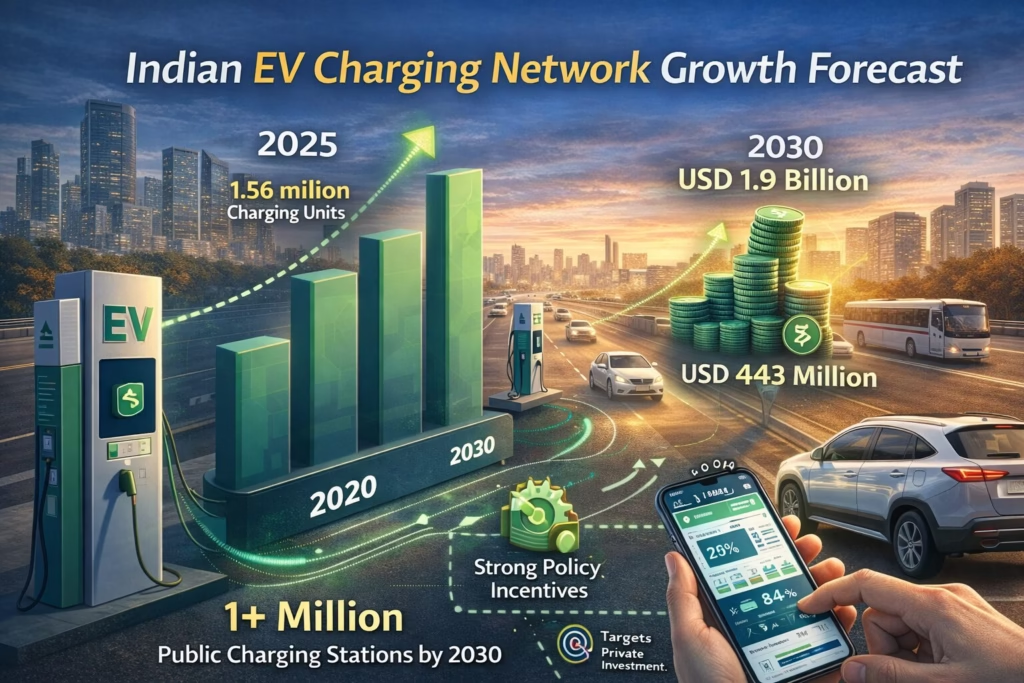
- The market is projected to grow from around USD 443 million in 2024 to nearly USD 1.9 billion by 2030 — a 27.8 % compound annual growth rate (CAGR).
- Other reports estimate the charging sector may balloon even further, with forecasts suggesting growth toward USD 3.7 billion by 2030 at roughly 22 % CAGR.
These figures cover both slow (AC) and fast (DC) charging infrastructure, with fast chargers generally expected to capture larger revenue share due to rising demand for quicker fills.
Volume Forecasts: Chargers by the Numbers
Analysts also project how many physical charging points India might have in the coming decade:
Units Installed (2025–2035)
- The total number of installed charging units in India may reach around 1.56 million by 2025.
- By 2035, that figure could grow to roughly 11.58 million charging units, implying more than a six-fold increase over ten years — a CAGR of about 22 %.
This estimate includes both public and semi-public charging infrastructure and reflects broad national rollout.
Charging Station Targets and Policy Goals
Government and Industry Targets
Government and industry bodies have outlined ambitious infrastructure requirements to match EV adoption targets:
- A report commissioned by industry bodies suggests India may need nearly 1.32 million public charging stations by 2030 to support a projected EV market share of roughly 30 %.
- Bureau of Energy Efficiency (BEE) has drafted city-level plans aiming for about 46,000 public stations by 2030 in nine major Indian cities alone.
These targets underline how charging network expansion must match EV growth — or risk holding it back.
Growth Drivers Behind the Forecast
Several key forces are driving forecasted growth:
1. Government Incentives and Policy
The central government’s PM E-DRIVE and EV Mitra schemes allocate substantial funding and incentives for nationwide charging network deployment.
The Ministry of Power’s guidelines also encourage private sector participation and streamlined charger setup procedures across states.
2. Public-Private Partnerships
State governments and public sector units (PSUs) like IOCL, BPCL and HPCL are installing chargers at fuel stations and key public locations, boosting accessibility.
Recent private sector initiatives — such as VinFast’s tie-up with HPCL to install chargers at fuel pumps — further deepen coverage.
3. EV Adoption Momentum
Growing EV sales — including cars, two-wheelers, and commercial electric vehicles — create charging demand across segments, making infrastructure deployment commercially viable.
Regional Deployment Patterns
Charging network growth varies widely across India:
- States like Maharashtra, Delhi, and Karnataka are leading in charger installation density.
- Tier-2 and tier-3 cities are gaining focus as adoption spreads, driven by state policies and private charging initiatives.
Effective regional planning is critical to avoid charging deserts — areas where EV users lack viable public charging access.
Fast Charging and Future Tech Integration
Fast chargers (DC) are becoming increasingly important, especially as electric cars and high-use fleet vehicles grow in number. Revenue models often highlight fast chargers as a key growth segment.
Looking further ahead, next-generation infrastructure like bi-directional chargers (supporting vehicle-to-grid use), and even dynamic wireless charging corridors could figure into long-term network plans, aligning charging infrastructure closely with smart cities and grid modernization.
Challenges to Growth
Despite optimistic forecasts, roadblocks remain:
- Infrastructure deployment must keep pace with fast EV adoption to avoid range anxiety and charger congestion.
- Standards and interoperability issues can slow seamless charger use across different brands and networks.
- Rural and remote connectivity needs more attention to ensure equitable access nationwide.
Still, coordinated policy, public investment and private initiative form a strong foundation for growth.
What the Forecast Means for EV Users
More Chargers = Less Range Anxiety
Fast expansion means more accessible public and semi-public chargers, reducing the fear of running out of power during city travel or road trips.
Greater Investment Spurs Innovation
New stations attract technology innovation — smarter chargers, integrated payment systems, real-time status tracking, and improved user experience.
More Jobs and Economic Value
Infrastructure rollout drives economic activity in installation, operation, maintenance, and related services.
Summary
India’s EV charging network is poised for exponential growth between 2025 and 2035, with estimates showing market expansion from hundreds of thousands of chargers to millions of units in the coming decade. Revenue forecasts place the charging ecosystem in the multi-billion-dollar range by 2030, supported by strong policy incentives, rising EV sales, and collaborative public-private efforts. Meeting growth targets like 1 million+ public stations by 2030 will be critical to catalyze EV adoption across passenger, commercial, and fleet segments. With consistent effort, India’s charging network will transition from early stage to mainstream infrastructure — making electric mobility more accessible and convenient for all.