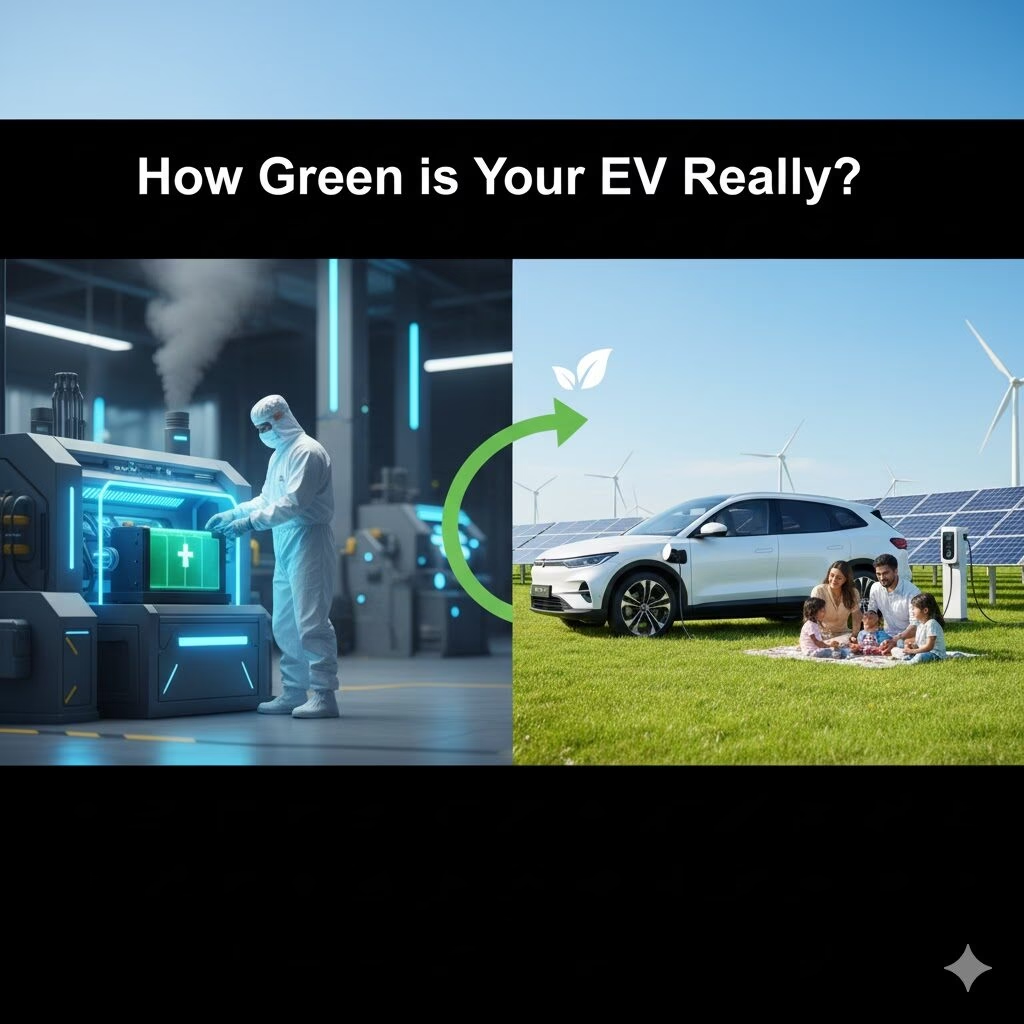
You made the switch to an electric vehicle. You feel good about zero tailpipe emissions and cleaner air. But then someone asks: “Isn’t your EV just powered by coal? How green is your EV really?” It’s a fair question. In a country where over 70% of electricity comes from fossil fuels, the environmental benefit of an EV isn’t as simple as “zero emissions.”
This isn’t about dismissing EVs. It’s about honest, data-driven clarity. The true green credentials of your electric car depend entirely on one thing: India’s electricity grid mix. Let’s trace the electrons powering your EV back to their source.
The Coal in the Room: India’s Current Grid Reality
First, let’s confront the hard numbers. As of 2024, India’s electricity generation is dominated by fossil fuels.
India’s Electricity Generation Mix (Source: CEA, Feb 2024):
- Coal: 73.2% (The dominant source)
- Renewables (Solar, Wind, etc.): ~22% (Rapidly growing)
- Large Hydro: ~9%
- Nuclear & Others: ~5%
This means when you plug in your Tata Nexon EV in most parts of India, there’s a ~73% chance the electron filling its battery was generated by burning coal. This is the “Well-to-Wheel” emissions that critics point to.
The Calculation: EV Emissions vs. Petrol Car Emissions
So, does this make an EV as dirty as a petrol car? Not even close. Let’s do the math.
Assumptions:
- EV: Tata Nexon EV (30 kWh battery, efficiency: 0.115 kWh/km)
- Grid Emission Factor: 0.82 kg CO2/kWh (India’s average CO2 emitted per unit of electricity generated, as per Central Electricity Authority).
- Petrol Car: Hyundai Creta (Mileage: 15 km/l, Petrol CO2: ~2.3 kg/l).
Per Kilometer Emission Calculation:
- Nexon EV:
- Energy use per km = 0.115 kWh
- Emissions per km = 0.115 kWh * 0.82 kg CO2/kWh = 0.094 kg CO2/km
- Petrol Creta:
- Petrol use per km = 1/15 = 0.067 litres
- Emissions per km = 0.067 l * 2.3 kg CO2/l = 0.154 kg CO2/km
The Result: Even on India’s coal-heavy grid, the Nexon EV emits approximately 40% less CO2 per kilometer than a comparable petrol SUV. This gap widens dramatically as the grid gets greener.
Beyond Tailpipes: The Full Lifecycle Analysis
The “green” question must look at the entire lifecycle:
- Manufacturing: EV production, especially the battery, has a higher carbon footprint than a petrol car.
- Use Phase: This is where EVs shine, as calculated above.
- End-of-Life: Battery recycling is evolving but promises a circular economy.
Critical Insight: Studies show that despite the higher manufacturing emissions, an EV in India breaks even with a petrol car within 1-2 years of driving and becomes net greener thereafter over its lifetime.
The Game Changer: Your Personal Energy Choices
This is where you have real power. The grid average is one thing, but your personal EV footprint can be much cleaner.
How to Make Your EV Genuinely Green:
- Charge with Solar: Install rooftop solar panels. This is the gold standard. Your EV runs on 100% clean energy, and excess solar can power your home.
- Real-life example: A homeowner in Bangalore charges his MG ZS EV with a 3kW rooftop solar system, making his daily commute truly zero-emission.
- Choose a Green Energy Tariff: Some DISCOMs (like Tata Power in Delhi, Mumbai) offer “Green Power” tariffs where you pay a small premium to ensure your electricity comes from renewable sources.
- Time Your Charging: Charge during the day, especially midday, when solar generation is at its peak on the national grid.
The Future is Getting Brighter (and Greener)
The grid mix is not static. India is on a massive renewable energy push.
- Target: 500 GW of non-fossil fuel capacity by 2030.
- Current Trend: Renewable share is increasing by 1-2% every year.
This means every year, your existing EV automatically gets greener as the grid it charges from adds more solar and wind. A petrol car’s emissions are fixed the day it leaves the factory.
Key Takeaways: How Green is Your EV Really?
- Greener Today: Even on the current coal-heavy grid, a typical EV in India emits 30-50% less CO2 over its lifetime compared to a petrol car.
- Your Choices Matter: By pairing your EV with rooftop solar or a green energy plan, you can approach near-zero driving emissions.
- Self-Cleaning Asset: Your EV’s carbon footprint will shrink over its lifetime as India’s grid decarbonizes. A petrol car’s will not.
- Beyond CO2: EVs also eliminate deadly local air pollutants (NOx, PM) in cities, a massive public health benefit regardless of the power source.
Conclusion: A Clear, if Nuanced, Verdict
So, how green is your EV really? The answer is: Significantly greener than the alternative, and getting better every day.
It is not a perfect, zero-impact solution today because no machine is. But it is a crucial, dramatically cleaner step in the right direction. By choosing an EV, you’re not just buying a car; you’re buying into an energy ecosystem that is unequivocally moving towards renewables. You’re future-proofing your transport against a carbon-constrained world.
The most powerful action you can take now? Pair your EV with clean energy. That’s when you move from driving a “lower-emission” vehicle to driving a truly transformative one.
Frequently Asked Questions (FAQs)
Q1: What about the environmental damage from mining lithium for EV batteries?
This is a valid concern. Lithium and cobalt mining have environmental and ethical impacts. The industry is responding with better mining practices, battery recycling mandates (like India’s proposed battery swapping policy), and new chemistries like Lithium Iron Phosphate (LFP) that use no cobalt. The overall environmental impact is still lower than the continuous extraction and burning of fossil fuels.
Q2: Are EVs in states with more renewables, like Karnataka, cleaner than in coal-dependent states?
Absolutely. An EV charged in Karnataka (with ~50% renewable energy share) will have a significantly lower carbon footprint per km than one charged in a state like Odisha or Gujarat that relies more on coal. Your location matters.
Q3: How does the efficiency of power plants affect this calculation?
Even accounting for transmission losses and coal plant efficiency (typically 30-35%), EVs come out ahead. Centralized power generation in large plants is inherently more efficient than thousands of small, mobile internal combustion engines in cars (which are only 20-30% efficient).
Q4: What is the carbon payback time for an EV in India?
Most studies indicate that an EV in India offsets its higher manufacturing emissions within 15,000 to 25,000 km of driving (roughly 1-2 years for an average driver). After that, it’s all net environmental gain.
Q5: Should I wait for the grid to get greener before buying an EV?
No. The best time was yesterday, the second-best time is now. By buying an EV today, you:
a) Start reducing your emissions immediately.
b) Support the industry and infrastructure that enables the green transition.
c) Own an asset that cleans itself as the grid improves. Waiting means continuing to emit at the higher, fixed rate of a petrol car.