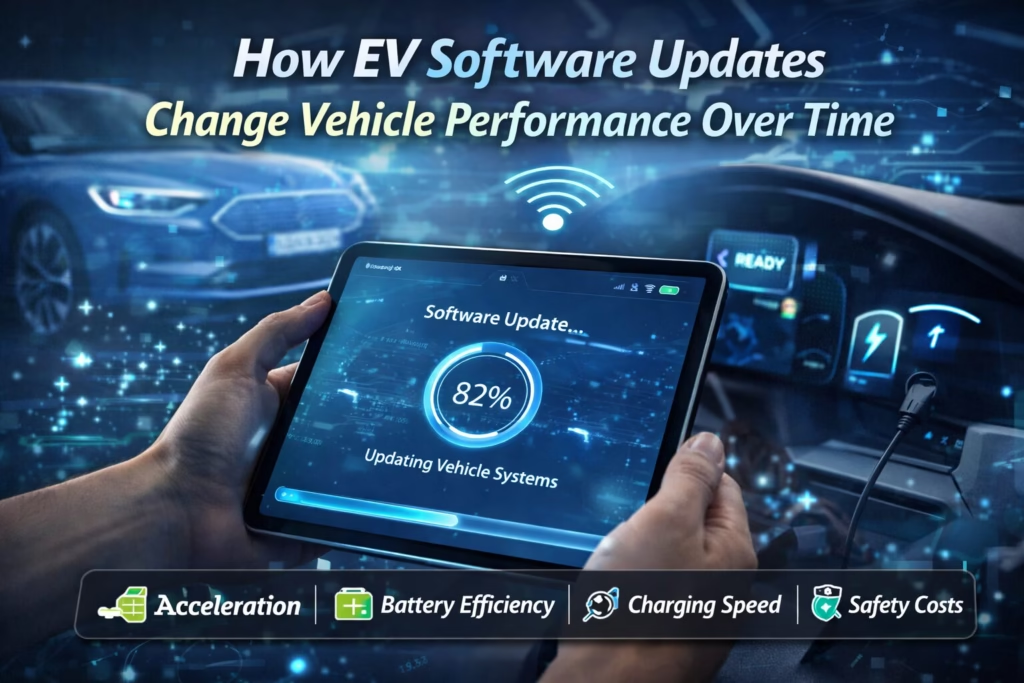
Electric vehicles are no longer defined only by motors, batteries, and hardware. Software now plays a central role in how an EV performs, drives, charges, and ages. Over time, manufacturers release software updates that can change acceleration response, range behavior, charging speed, safety systems, and even driving comfort. For EV owners, these updates quietly shape the real ownership experience long after purchase.
This article explains how EV software updates affect vehicle performance over time, what actually changes inside the car, and what owners should realistically expect from these updates.
Quick Answer
EV software updates can modify power delivery, improve battery management, adjust charging behavior, refine driver assistance systems, and fix performance inefficiencies. While updates rarely increase raw motor output dramatically, they often improve usable range, smoother acceleration, better thermal control, and safer driving behavior as the vehicle ages.
What Are EV Software Updates?
EV software updates are digital improvements sent to the vehicle’s onboard systems. Most modern EVs receive updates either over the air or during service visits. These updates control:
- Battery management systems
- Motor control units
- Charging logic
- Thermal regulation
- Infotainment and driver assistance features
Unlike traditional cars, many EV functions depend on software instructions rather than fixed mechanical behavior.
How Software Updates Affect Acceleration and Power Delivery
Throttle Response Tuning
Early versions of EV software may deliver aggressive torque at low speeds. Over time, manufacturers often adjust throttle mapping to:
- Improve smoothness in traffic
- Reduce wheel spin on wet roads
- Improve efficiency during city driving
These changes do not usually reduce total power but reshape how quickly power is delivered.
Torque Management Adjustments
Software can limit or redistribute torque to protect drivetrain components as the vehicle ages. This is common in performance EVs and helps maintain long term reliability without noticeable performance loss.
Battery Performance Changes Over Time
Battery Management System Improvements
The battery management system controls charging limits, temperature behavior, and cell balancing. Software updates often:
- Improve accuracy of state of charge readings
- Reduce sudden range drops
- Improve consistency in cold or hot weather
These updates help drivers access more usable energy without stressing the battery.
Degradation Control
As batteries age, software may slightly adjust charging curves to reduce long term wear. This can mean:
- Slower charging at very high states of charge
- More stable battery temperatures
- Longer battery lifespan
This protects battery health even if peak charging speed reduces slightly at later stages.
Impact on Driving Range
More Accurate Range Estimates
Early EV software versions often provide optimistic range estimates. Updates usually improve prediction models by learning real world driving patterns. This results in:
- Fewer unexpected range drops
- More reliable trip planning
- Better confidence during long drives
Efficiency Gains
Small software improvements in motor control and regenerative braking can improve efficiency by a few percentage points. Over thousands of miles, this translates into meaningful energy savings.
According to research from the U.S. Department of Energy, software controlled efficiency improvements can recover measurable energy losses over time.
Charging Speed and Charging Behavior
Charging Curve Refinement
EVs do not charge at constant speed. Software updates refine charging curves to balance speed and battery protection. Updates may:
- Increase mid range charging speed
- Reduce overheating at fast chargers
- Improve consistency across different charger brands
Compatibility With New Chargers
As public charging infrastructure evolves, software updates help EVs communicate better with newer chargers. This reduces failed sessions and improves charging stability.
The National Renewable Energy Laboratory highlights that charger communication software plays a major role in real world charging reliability
https://www.nrel.gov/transportation
Thermal Management and Climate Control
Battery Cooling Logic
Thermal control software manages battery temperature during driving and charging. Updates may:
- Activate cooling earlier in hot conditions
- Reduce energy waste during mild weather
- Improve winter performance
Better thermal control improves both performance stability and battery longevity.
Cabin Climate Efficiency
Climate systems in EVs consume significant energy. Software updates often optimize:
- Heat pump usage
- Fan behavior
- Temperature ramping
This improves comfort while reducing energy loss.
Driver Assistance and Safety Performance
ADAS Refinements
Advanced driver assistance systems depend heavily on software. Updates improve:
- Lane keeping accuracy
- Adaptive cruise smoothness
- Emergency braking response
These changes improve safety and reduce driver fatigue without requiring new hardware.
Stability and Traction Control
Software updates can refine traction control behavior, especially on slippery surfaces. This improves confidence during rain or uneven road conditions.
The National Highway Traffic Safety Administration emphasizes the role of software updates in improving vehicle safety systems
https://www.nhtsa.gov/road-safety
Infotainment and User Experience Effects
While infotainment does not directly affect driving performance, it influences driver behavior. Updates may:
- Reduce system lag
- Improve navigation accuracy
- Improve energy consumption routing
Better navigation helps drivers choose routes that improve range and charging efficiency.
Can Software Updates Increase EV Performance?
In rare cases, manufacturers release updates that unlock additional performance margins after validation. More commonly, updates focus on:
- Smoother delivery rather than higher output
- Consistent performance across conditions
- Reduced wear on components
Performance feels better over time even if peak numbers remain unchanged.
Real World Example Behavior
Many EV owners notice that after updates:
- Acceleration feels smoother in city traffic
- Charging sessions complete more consistently
- Range predictions become more reliable
- Climate control uses less energy
These changes may seem subtle individually but combine to improve daily ownership.
Limitations of Software Updates
Software cannot change physical limits. Updates cannot:
- Increase battery size
- Change motor hardware
- Eliminate natural battery aging
They improve how existing systems operate within safe limits.
FAQs
Do EV software updates affect resale value?
Yes. Vehicles with updated software often show better efficiency, stability, and safety performance, which supports resale confidence.
Can software updates reduce performance?
Updates rarely reduce usable performance intentionally. Any reduction usually protects battery health or drivetrain reliability.
Do older EVs benefit from updates?
Yes, although hardware limits how much improvement is possible.
Are updates mandatory?
Safety related updates are often mandatory. Feature updates are usually optional but recommended.
Summary
EV software updates quietly shape vehicle performance throughout ownership. They refine acceleration behavior, improve battery efficiency, stabilize charging, and strengthen safety systems. While updates do not transform an EV into a different machine, they steadily improve how the vehicle performs in real world conditions.
As electric vehicles continue to evolve, software will remain one of the most important factors influencing long term performance, efficiency, and ownership satisfaction.