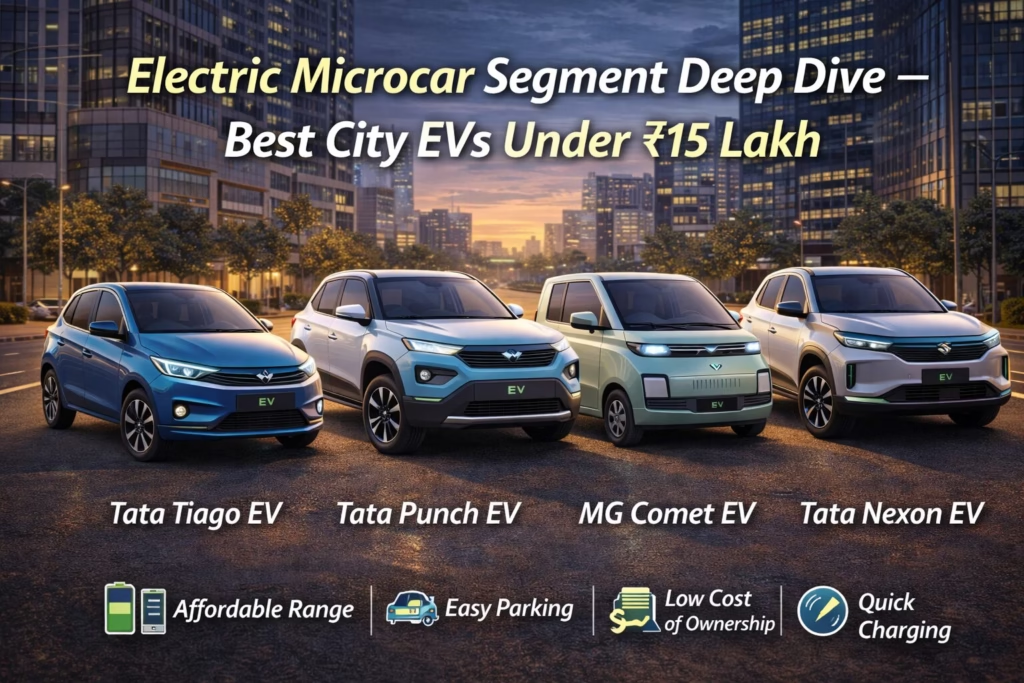
Small electric cars are now the most practical way for many Indians to switch to zero-emission driving. For city use—short trips, tight parking, frequent stops—microcars and compact EVs offer the best mix of low running cost, easy manoeuvrability, and useful range. This guide reviews the strongest options under ₹15 lakh, explains ownership math for city drivers, and gives clear buying tips so you pick the right small EV for urban life.
Quick answer
If you want an affordable city EV under ₹15 lakh, the standouts in 2025 are Tata Tiago EV, Tata Punch EV, MG Comet EV, and entry trims of Tata Nexon EV — these models balance price, usable real-world range, and charging practicality for daily urban use.
Why the microcar segment matters for cities
Micro/compact EVs are designed for short trips, low running costs, and minimal parking hassle. They typically:
- Cost far less per km to run than petrol cars, especially when charged at home.
- Require smaller batteries (so lower purchase price) yet give enough range for day-to-day city driving.
- Offer smaller turning radius and easier parking in tight urban spaces.
Government charging standards and rollout plans are improving the convenience of city ownership (see Ministry of Power charging guidelines).
Top city EV picks under ₹15 lakh (at-a-glance)
| Model | Typical ex-showroom price (India) | Usable city range (real world) | Why it works for cities |
|---|---|---|---|
| Tata Tiago EV | ~₹7.99–11.14 L | 250–315 km (variants) | Lowest cost of entry, good range for daily use. |
| Tata Punch EV | ~₹9.99–14.44 L | 315–421 km (variants) | Compact SUV shape, high seating, practical for mixed city/suburban use. |
| MG Comet EV | ~₹6–10 L | ~200–230 km | Extremely compact footprint, ideal for tight city streets and single/family use. |
| Tata Nexon EV (base/older trims) | ~₹12–13 L (select trims) | 300–380 km | Bigger than a microcar but often available within budget — strong value. |
Note: Prices are ex-showroom averages and vary by city, variant, and promotions. Always confirm on dealership pages.
How to choose the right city EV (short checklist)
- Daily km and charging habit — if you do <80 km daily and can charge at home, even smaller batteries work fine.
- Parking & footprint — narrow lanes and dense neighborhoods favor very compact models like MG Comet.
- Charging options — depot/home charging vs relying on public fast chargers changes the best choice; home charging makes smaller battery models economical. See the central guidelines for charger installation and operations.
- Total cost of ownership — factor in electricity tariff, maintenance savings, incentives and resale expectations. Typical EV energy cost per 100 km in India often works out far lower than petrol equivalent (electricity cost estimates and local tariffs vary).
Ownership math for the city driver
Energy and maintenance are where EVs save you money:
- Energy cost: If an EV consumes ~15 kWh/100 km and your charging cost is ₹8–12/kWh, energy cost ≈ ₹120–180 per 100 km (rough average used by operators). Public fast-charging rates vary and can be higher.
- Maintenance: EVs have fewer moving parts — no oil changes, simpler drivetrains, and less brake wear thanks to regeneration. Many owners report noticeably lower scheduled maintenance spend.
- Incentives: Several states still offer registration and road-tax benefits (check local policy before purchase).
If you commute 40–50 km a day and charge mostly at home, many compact EVs pay back the price premium over an ICE car within a few years through energy and servicing savings.
Practical pros & cons of the microcar choice
Pros
- Lowest purchase and operating cost in the EV lineup.
- Easier parking and driving in dense areas.
- Good environmental and noise benefits for cities.
Cons
- Limited top speed and long-distance comfort compared with larger EVs.
- Battery size limits if you frequently take long highway trips.
- Public DC fast charging access improves but still inconsistent in some cities (refer to government guidelines on charging rollout).
Charging reality for city owners
For most microcar owners:
- Home AC charging (overnight) handles daily needs and is the cheapest route.
- Public DC fast chargers are useful for occasional intercity legs, but you’ll plan stops. The central government’s recent charging and battery-swap guidelines aim to improve availability and interoperability.
If you live in an apartment/complex, check whether your building management allows charger installation or has EV-ready parking — that’s increasingly a municipal requirement or recommendation in many regions.
Short comparisons (who should pick which)
- Budget urban commuter: MG Comet EV or Tata Tiago EV (lowest cost, easiest to park).
- Small SUV feel with city practicality: Tata Punch EV — higher ride height, roomy interior.
- One step up for occasional highway use: Tata Nexon EV (select trims within ₹15L) — bigger battery, more comfort.
Helpful resources (links)
Internal guides
- Public charging station primer — EVSpec: Public Charging Stations.
- How to calculate cost per km for your EV — EVSpec: Calculate exact cost per km.
- Technology deep dives — EVSpec: EV Technology articles.
Authoritative external references
- Ministry of Power — Charging infrastructure guidelines.
- Bureau of Energy Efficiency — charging installation guidelines.
- Independent analysis on charging economics and infrastructure (CEEW / research dossiers).
FAQs
Q: Are micro EVs safe for family use?
A: Yes—most modern micro EVs meet safety norms for their class. Check variant-level safety devices (airbags, ESC) before buying.
Q: Will a small battery be a problem on weekends?
A: Not if you plan trips and use public chargers for longer legs. For routine weekend excursions under 200 km, many city EVs manage well.
Q: How long does home charging take?
A: With a 7–7.2 kW AC charger, most micro EV batteries charge overnight (4–8 hours depending on battery size).
Q: Do I need special permissions to install a home charger?
A: Guidelines from central authorities make residential EV charging straightforward, but check building rules and local DISCOM procedures.
Short summary
For city use in India, micro and compact EVs under ₹15 lakh now offer a compelling ownership experience: low running costs, easy parking, and enough range for daily needs. Pick a model by matching your daily kilometres and charging access — Tata Tiago EV and MG Comet EV for tight-city budgets; Tata Punch EV if you want compact-SUV ergonomics; consider entry Nexon EV trims if you need extra range. Follow charger installation guidance and factor electricity tariffs into your cost calculations to get the most value.