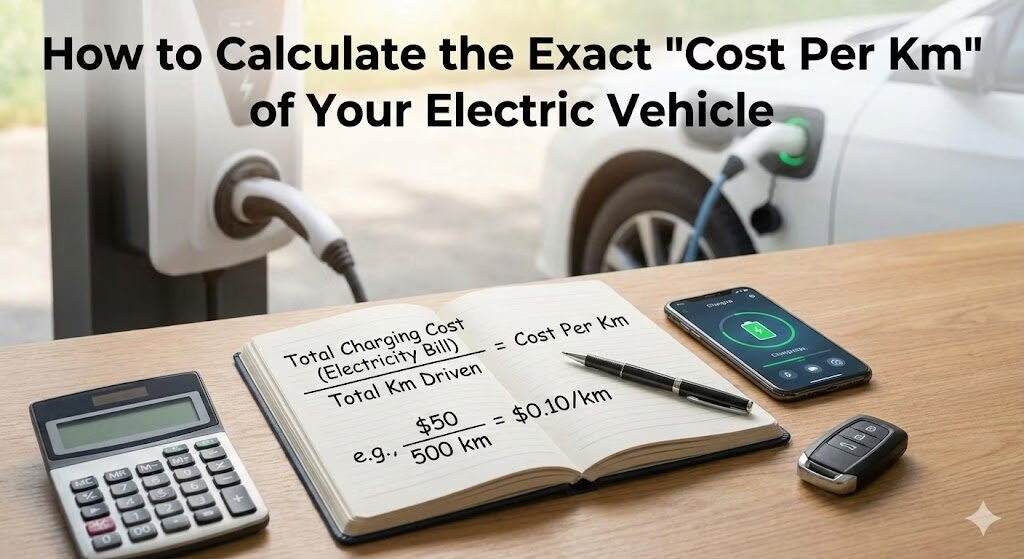
As electric vehicles gain popularity across India, one question potential buyers consistently ask is: “What will it actually cost to run?” While manufacturers tout lower running costs, understanding how to calculate the exact electric car running cost per km empowers you to make an informed financial decision. This isn’t just about hype; it’s about hard data.
This definitive guide will walk you through a transparent, step-by-step process to calculate your true cost per kilometer, acting as your personal EV running cost calculator India. We’ll use real-world numbers and compare them directly with petrol vehicles, so you can see the savings in black and white.
Why Calculating Your True EV Cost Per Km Matters
Simply trusting advertised “low running costs” isn’t enough. A precise calculation helps you:
- Justify the Upfront Investment: Understand how long it will take to offset a higher purchase price through fuel savings.
- Budget Accurately: Forecast your monthly and annual transportation expenses.
- Compare Fairly: Make an apples-to-apples comparison between an EV and a petrol/diesel car using an EV vs petrol calculator India methodology.
The Fundamental Formula for Cost Per Km
The core calculation is simple:
Cost Per Km (₹/km) = Total Cost of Energy to Travel a Certain Distance (₹) / Distance Travelled (km)
The challenge lies in accurately determining the “Total Cost of Energy.” Let’s break it down.
Step 1: Calculate Your Electricity Charging Cost
This is the most significant part of the electric car running cost per km. You need to know your electricity tariff, which varies by state and consumer slab.
1. Find Your Electricity Rate:
Check your latest electricity bill. The domestic rate in India typically ranges from ₹4 to ₹8 per kWh (Unit). For this guide, we’ll use a conservative average of ₹8/kWh.
2. Know Your EV’s Efficiency:
This is how much energy your car uses, measured in Wh/km (Watt-hours per kilometer). You can find this in the vehicle’s manual or real-world owner reviews.
- Example: Tata Nexon EV (Long Range) has a real-world efficiency of about 115 Wh/km (or 0.115 kWh/km).
3. Perform the Calculation:
Using the Tata Nexon EV charging cost per km as our example:
- Cost per km = (Electricity Rate in ₹/kWh) x (Efficiency in kWh/km)
- Cost per km = ₹8/kWh x 0.115 kWh/km
- Cost per km = ₹0.92
This means, at ₹8/unit, it costs less than One Rupee to drive a Tata Nexon EV for one kilometer.
Your Turn: Use this as your EV charging cost calculator India. Plug in your local electricity rate and your EV’s efficiency.
- (Your Electricity Rate ₹/kWh) x (Your EV’s Efficiency kWh/km) = Your Charging Cost per Km
Step 2: Factor in Other Running Costs (The Hidden Variables)
A true electric car cost per km calculator must account for more than just electricity.
- Maintenance Cost per Km: EVs have no engine oil, spark plugs, or fuel filters. Maintenance costs are significantly lower.
- *Estimate: ₹0.25 – ₹0.50 per km* (compared to ₹1.00 – ₹2.00 for a petrol car).
- Tyre Wear Cost per Km: Tyres wear out based on distance.
- *Estimate: ₹0.30 – ₹0.60 per km* (similar for both EV and petrol).
- Insurance Cost per Km: EVs can have slightly higher insurance premiums.
- *Estimate: ₹0.50 – ₹1.00 per km*.
Step 3: The Complete Calculation – Total Cost Per Km
Let’s calculate the total cost for our Tata Nexon EV example, assuming annual driving of 15,000 km.
| Cost Component | Calculation (Annual) | Cost Per Km |
| Charging Cost | 15,000 km * ₹0.92/km | ₹0.92 |
| Maintenance | ₹4,500 / 15,000 km | ₹0.30 |
| Tyres | ₹6,000 / 60,000 km | ₹0.10 |
| Insurance | ₹25,000 / 15,000 km | ₹0.60 |
| Total Cost Per Km | ₹1.92 |
This holistic view gives a more accurate picture, though the electric car running cost per km is still dominated by the charging cost.
Step 4: Create Your Own EV vs Petrol Calculator in Excel
An EV vs petrol calculator Excel sheet is the best way to personalize this comparison.
- Create a table with the following columns: Cost Component, EV Cost (₹/km), Petrol Car Cost (₹/km).
- Input your data:
- EV Charging Cost: Use the formula from Step 1.
- Petrol Fuel Cost: (Petrol Price ₹/l) / (Car’s Mileage km/l). *e.g., (₹105/l) / (15 km/l) = ₹7.00/km.*
- Maintenance: EV: ₹0.30/km, Petrol: ₹1.50/km.
- Add rows for Tyres, Insurance, etc.
- Use the SUM function to calculate the total cost per km for both vehicles.
The difference in the “Total” row will visually demonstrate your annual savings.
Real-World Comparison: EV vs. Petrol Car in India
Let’s use our EV vs petrol calculator India logic for a quick, high-level comparison for 15,000 km/year.
| Metric | Electric Car (e.g., Nexon EV) | Petrol Car (e.g., Nexon Petrol) |
| Fuel/Electricity Cost | ₹0.92/km | ₹7.00/km |
| Annual Fuel Cost | ₹13,800 | ₹1,05,000 |
| Annual Maintenance | ~₹4,500 | ~₹22,500 |
| Total Annual Running Cost | ~₹18,300 | ~₹1,27,500 |
| Annual Savings with EV | ₹1,09,200 |
Disclaimer: These are illustrative figures. Actual costs will vary based on driving style, location, and specific vehicle models.
Conclusion: Knowledge is Power (and Savings)
Calculating your exact electric car running cost per km demystifies EV ownership. As we’ve shown, even with a comprehensive calculation that includes maintenance and insurance, the running cost of an EV is a fraction of that of a petrol car. The initial investment is higher, but the dramatic reduction in running costs means the EV often pays for the price difference over time.
By using the steps in this guide as your personal EV running cost calculator India, you can move beyond speculation and make a confident, data-backed decision about your next vehicle purchase.
Frequently Asked Questions (FAQs)
Q1: Is the cost per km calculation the same for electric scooters?
Yes, the formula is identical. You would use the scooter’s efficiency (e.g., 40 Wh/km for an Ather 450X) and your electricity rate to find the charging cost per km.
Q2: How does using public fast chargers affect the cost per km?
Public DC fast chargers are more expensive, typically costing ₹15-₹18 per kWh. This would increase the Tata Nexon EV charging cost per km to around ₹1.70 – ₹2.07, which is still significantly cheaper than petrol.
Q3: Why is maintenance cheaper for an EV?
EVs have far fewer moving parts—no engine, transmission, clutch, or exhaust system. This means no oil changes, no spark plug replacements, and fewer components that can fail.
Q4: Does the calculation change if I install a solar panel at home?
Absolutely. If you charge your EV using solar power, your effective electricity cost drops to nearly zero, reducing your electric car running cost per km to just maintenance and tyre wear.
Q5: How accurate is the efficiency figure (Wh/km) from the manufacturer?
Manufacturer figures are often optimistic, achieved under ideal test conditions. For a more accurate EV charging cost calculator India estimate, rely on real-world owner reviews and long-term test reports.